 blog
Process Server vs Sheriff for Evictions: Which to Use
Last Updated: October 30, 2026
Quick Summary
A process server vs sheriff for evictions choice depends on whether you need papers served or an order enforced. Private servers offer evening and weekend attempts and faster scheduling, while sheriff's offices charge statutory fees but only the sheriff can physically remove occupants under a writ of possession.
- A private server can serve papers but cannot physically remove a tenant.
- Only the sheriff's office carries out the physical eviction after a writ of possession.
- Private servers may attempt service in evenings, weekends, and early mornings.
- Sheriff's service fees are set by statute or county schedule; confirm current rates.
- Check local court rules and confirm your server's appointment before hiring anyone.
Table of Contents
- What a Process Server and a Sheriff Each Do in an Eviction
- Who Serves Eviction Papers in Florida: Private Servers and Sheriff's Offices Compared
- How Long It Takes to Serve Eviction Papers and What Affects Timing
- What Happens If a Process Server Can't Serve Papers
- Proof of Service for Eviction Papers and Booking Your Next Step
- Frequently Asked Questions
What a Process Server and a Sheriff Each Do in an Eviction
When a landlord files an eviction case in Florida, the court needs proof that the tenant received the papers. That proof is what the process server vs sheriff for evictions decision is really about.
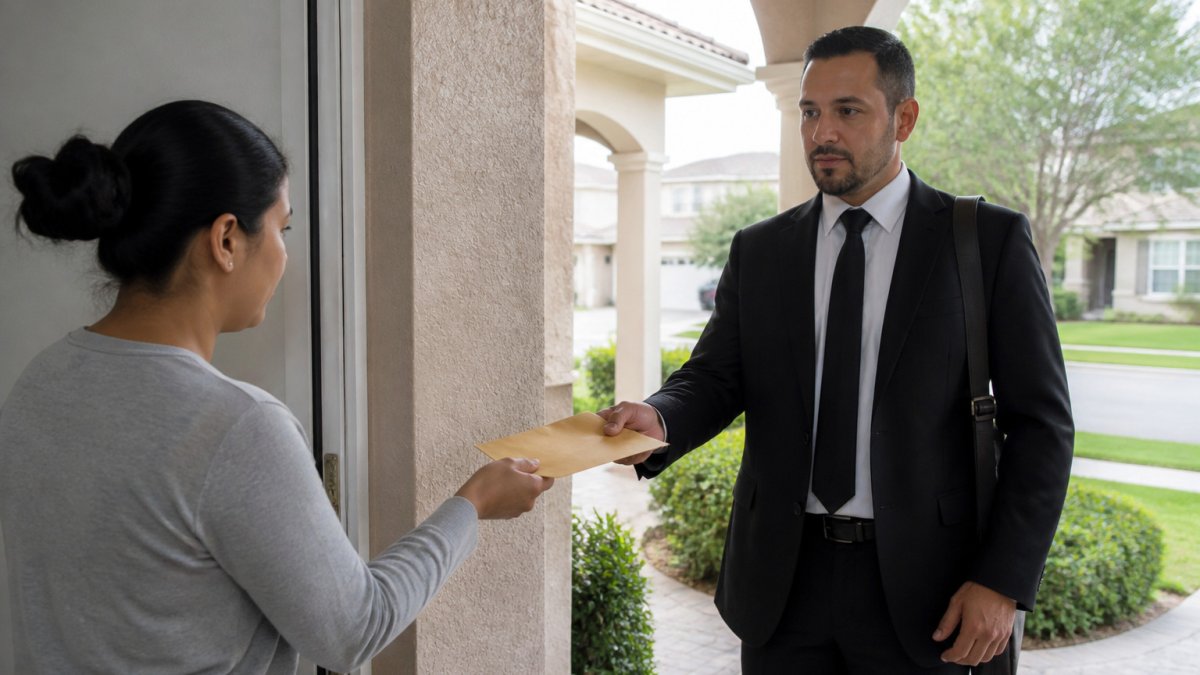
A process server is a private person or company appointed to deliver court documents. For the practical steps involved, read our step-by-step guide to serving Florida eviction papers.
Serving eviction notices versus carrying out a physical eviction
This distinction causes the most confusion. Serving papers means delivering them so the tenant knows about the case or the order. A process server or sheriff does that work.
Carrying out an eviction is different. Once a court issues a writ of possession, the sheriff's office is the agency that enforces it and removes the occupants (Unlawful Detainer Instructions). A private process server cannot physically remove a tenant.
Who Serves Eviction Papers in Florida: Private Servers and Sheriff's Offices Compared
Both options are common in Florida, and each has real trade-offs. If you want to see how a private server handles the work, explore our process serving services. The comparison below focuses on what actually differs in practice: who is authorized to serve, how fees are structured, how scheduling works, and how proof of service is documented.
Private process servers
- Authority: A private server must be appointed or licensed under the applicable Florida rules and local court requirements. Many are also registered in the county where they serve. Always confirm the server's appointment status before hiring.
- Fees: Private server fees vary by provider and depend on factors such as mileage, rush requests, and additional attempts. Ask for an itemized quote so you can compare providers on the same terms.
- Scheduling: Evening, weekend, and early-morning attempts may be possible depending on the provider and the case.
Sheriff's offices
- Authority: Sheriff's deputies serve process as part of their statutory duties. Their service is recognized by the court without additional appointment steps.
- Fees: Sheriff's service fees are set by statute or county schedule. Confirm the current fee schedule with your county sheriff's civil division.
- Scheduling: Sheriff's service is generally handled through the civil division during business hours. Confirm current procedures with your county sheriff.
How to verify who may serve eviction papers in your county
Who may serve eviction papers, what methods are permitted, and what deadlines apply vary by state and county. Before you hire anyone, run this checklist:
- Check the court's local rules or standing orders. Many courts publish service requirements, approved server lists, and special-server authorization procedures.
- Confirm the server's appointment or license. Ask for the appointment order, license number, or registration and verify it with the issuing court or agency.
- Confirm the permitted methods. Personal service, substituted service, and posting requirements differ by jurisdiction and by case type.
- Confirm the deadline. The number of days allowed for service after filing, and the consequences of missing it, are set by court rule.
- Confirm the proof-of-service form. Some courts require a specific affidavit format or additional declarations.
Do not assume a server authorized in one county is automatically authorized in another. Special-server appointments and local requirements can differ, and a defective service can be challenged or set aside.
A practical decision framework
Use these questions to choose between a private server and the sheriff's office:
- Is the task serving papers or enforcing an order? If you need a writ of possession enforced, only the sheriff's office can carry out the physical eviction. A private server cannot remove occupants.
- How urgent is the case? If a hearing date or deadline is close, a private server's faster scheduling and multiple attempt options usually matter more than the lower sheriff fee.
- Is the tenant hard to reach? If the tenant works odd hours or avoids the door, a private server's evening and weekend availability and skip-trace capability are advantages.
Your choice depends on urgency, recipient availability, local rules, and whether you are serving papers or enforcing an order. Learn more about how to choose a process server in our guide on how to hire a process server in Florida.
Florida requires that eviction papers be served properly before a case can move forward, so a sloppy or incomplete service attempt can delay the entire case. For more on our process serving work, visit usproservers.com.
The table below compares the two options on the points where they differ in practice.
| Factor | Private process server | Sheriff's office |
|---|---|---|
| Authority | Must be appointed or licensed | Serves as part of statutory duties |
| Fees | Varies; ask for itemized quote | Set by statute or county schedule |
| Scheduling | Evenings and weekends possible | Generally business hours |
| Proof of service | Affidavit of service from server | Return filed with the court |
| Main trade-off | Pay server fee on top of court costs | Costs and turnaround vary by county |
How Long It Takes to Serve Eviction Papers and What Affects Timing
Service timing is easier to plan when you see where it fits in the eviction sequence. A typical eviction moves through these stages:
- Notice, the landlord gives the tenant written notice to pay or vacate, as required by the applicable statute.
- Filing, the landlord files the eviction complaint with the court.
- Service, the tenant is served with the summons and complaint. This is the step a process server or sheriff handles.
- Hearing, the court schedules a hearing, often within a short window set by local rule.
- Judgment, the court enters a judgment for possession if the landlord prevails.
- Writ of possession, the court issues the writ, which authorizes enforcement.
- Enforcement, the sheriff's office carries out the physical eviction and removes occupants.
Service sits between filing and the hearing, so a delay at this stage pushes back every later step. That is why the server you choose and the number of attempts required matter more than most landlords expect.
What affects service timing
- How easy the tenant is to locate. A tenant who has moved or is avoiding service requires skip-trace work and additional attempts.
- Whether the tenant is home during the attempt. Attempts at different times of day, early morning, evening, weekend, improve the odds of personal service.
- How many attempts the server needs. Most servers include a set number of attempts in the base fee; additional attempts add time and cost.
Service deadlines and why they matter
Courts set deadlines for completing service after filing, and missing them can lead to dismissal or require an extension. The exact number of days and the consequences of missing the deadline are set by court rule and can differ by jurisdiction.
Rush service may be available for time-sensitive cases; ask about options when requesting a quote. Contact US Process Servers LLC at usproservers.com to ask about turnaround options for time-sensitive filings.
Ask any server for their typical turnaround, their included number of attempts, and their policy on repeat attempts. A clear, specific answer is a good sign, and it lets you compare providers on the same terms.
When timing should change your choice
- Deadline is close: A private server's faster scheduling and multiple attempt options usually outweigh the sheriff's lower fee.
- Tenant is hard to reach: Evening and weekend availability and skip-trace capability favor a private server.
- Case is not urgent and the tenant is easy to serve: The sheriff's lower statutory fee may be the better fit.
What Happens If a Process Server Can't Serve Papers
Sometimes a tenant avoids service. Common signs include no answer at the door, a tenant who has moved, or someone who refuses to accept the papers.
Next steps usually include:
- Making additional service attempts at different times of day
- Looking for alternate addresses or workplaces
- Asking the court about substituted service, if Florida law allows it in your case
Locating a hard-to-find tenant takes more than repeated visits. Our guide on how to locate someone evading service explains the search methods that help. Keep records of every attempt, since the court will want them.
Proof of Service for Eviction Papers and Booking Your Next Step
After service, the server completes a proof of service, sometimes called an affidavit of service. It records who received the papers, when, where, and how.
A complete affidavit protects the landlord. Missing or incorrect details can cause delays or dismissal, so check the form for accuracy before filing.
Choosing between a process server and a sheriff comes down to speed, cost, and control.
Frequently Asked Questions
Can a process server serve eviction papers?
Yes. In Florida, a process server who is a qualified private process server or a sheriff's deputy can serve eviction papers, including the notice and summons that start a landlord-tenant case. Serving papers is different from carrying out the eviction. Delivering the notice and summons is service of process, which a private process server can handle. Enforcing a judgment, such as a writ of possession and physical removal of the tenant, is generally handled by the sheriff. Confirm the requirements for your county with the clerk of court, since local practice varies.
What happens if the sheriff can't serve eviction papers?
If the sheriff's office cannot complete service, the case can stall while the landlord waits or retries. Attempts may be returned unserved with a notation, and the landlord typically has to request reissuance and pay additional fees. Private process servers may be able to make several attempts at different times of day, depending on the provider. Whichever server you use, the return of service must be filed with the court so the timeline can move forward.
What counts as proper proof of service for eviction papers?
Proof of service is a sworn or signed document, usually called a return of service or affidavit of service, stating who was served, when, where, and how. For personal service it identifies the person served. For substituted service, such as leaving papers with a resident of suitable age, it describes that person and the mailing or posting that followed. Florida courts and clerks require the return to be filed accurately, so errors in dates, addresses, or method can lead to delays or dismissal. Ask your server for clear, complete affidavits with photos where available.
Is a process server or a sheriff cheaper for eviction service?
Costs depend on the county, the number of attempts, mileage, and whether rush service is needed, so there is no single fee to quote. Sheriff's office service carries fees set by the county and statute, while private process servers charge their own rates. Compare itemized quotes that list the base service fee, additional attempts, and mileage. Contact US Process Servers LLC at usproservers.com for current pricing and a quote for your case.
Ready to move your eviction case forward? Contact US Process Servers LLC today to schedule reliable service for your Florida filing.