 how-to
How to Serve Eviction Papers in Florida: A Step-by-Step Guide
Table of Contents
- Understanding Eviction Notice Requirements Before Service
- How to Serve a 3-Day Notice in Florida
- Serving Other Notice Types: 7-Day and 15-Day Notices
- Delivery Methods and Service of Process for Eviction Papers
- Florida Eviction Summons Service and Court Filing
- Proof of Service for Eviction Papers: Documentation and Affidavits
- What Happens If a Tenant Avoids Eviction Papers
- Common Service Errors and How to Prevent Them
- Frequently Asked Questions
Last Updated: October 21, 2026
Understanding Eviction Notice Requirements Before Service
Before you serve eviction papers in Florida, you need to know which notice applies. Florida law requires specific notices before filing an eviction complaint, and the type depends on why the tenant must leave.
The three main notices are:
- 3-day notice for nonpayment of rent
- 7-day notice for lease violations
- 15-day notice for month-to-month tenancies
Each notice has strict requirements; missing one detail can delay or dismiss your case.
How to Serve a 3-Day Notice in Florida
The 3-day notice applies when a tenant fails to pay rent, the most common eviction scenario. You must serve it before filing an eviction complaint in court.
What the notice must include:
- The amount of rent owed
- The date rent was due
- A statement that the tenant must pay or vacate within 3 days
The 3-day period starts the day after service. Weekends and holidays count toward the 3 days.
Calculate the deadline correctly:
- Serve notice on Monday → deadline is Thursday
- Serve notice on Friday → deadline is Monday (weekend counts)
The notice must be in writing. Keep a copy for your records before you serve it.
Serving Other Notice Types: 7-Day and 15-Day Notices
The 7-day notice applies when a tenant violates the lease. Common violations include:
- Keeping unauthorized pets
- Running a business from a residential unit
- Damaging the property
The 7-day notice must describe the specific violation. Vague language like "lease violation" is not enough, state exactly what they did wrong and give them 7 days to fix it or leave.
The 15-day notice applies to month-to-month tenancies when you want to end the rental agreement without cause. This notice simply states that the tenancy will end in 15 days.
Both notices follow the same service rules as the 3-day notice. The period starts the day after service. Weekends and holidays count.
Delivery Methods and Service of Process for Eviction Papers
In Florida, "serving eviction papers" means two legally distinct acts:
- Serving the pre-filing notice (the 3-day, 7-day, or 15-day notice). This is a private act governed by the notice statutes. It happens before any case exists.
- Serving the summons and complaint. This is service of process in a court case. It is governed by the Florida Rules of Civil Procedure and, for eviction actions, by the summary procedure rules in Chapter 51.
The delivery methods overlap, but the rules, authorized servers, and proof requirements do not.
Serving the pre-filing notice
Florida Statutes § 83.56(3) (nonpayment and lease violations) and § 83.57 (terminating a tenancy without cause) set out how a notice may be delivered:
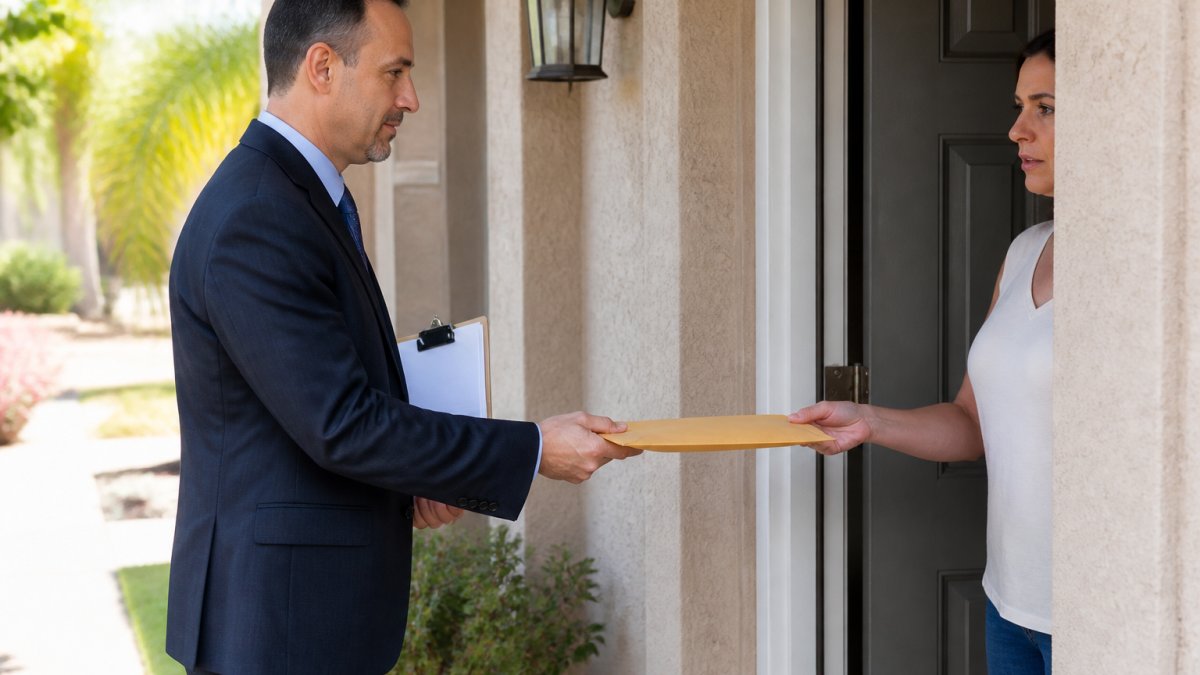
- Hand delivery to the tenant. The cleanest method. Hand the notice to the tenant personally and note the date, time, and who received it.
- Leaving a copy at the rental unit. If the tenant is absent from the premises, the notice may be left at the unit. A common and defensible practice is to leave the copy inside the unit in a conspicuous place, or attached to the door, and then also mail a copy to the tenant at the rental address.
- Mailing a copy. Send the notice by first-class mail, or by certified mail with return receipt requested if you want a delivery record. When you mail, the rules generally add time to the notice period: under § 83.56(3), if the notice is mailed, the tenant gets the stated period plus 5 additional days (excluding weekends and legal holidays) from the date of mailing.
A practical pattern: hand-deliver when you can; when you cannot, post a copy at the unit and mail a second copy the same day.
Who may serve the pre-filing notice
A landlord, property manager, or any competent adult can serve the pre-filing notice; no license is required. What matters is that the server can sign a clear, specific affidavit and is prepared to testify.
Serving the summons and complaint
Once you file the eviction complaint, the clerk issues a summons. Service of the summons is different:
- Who may serve. Under Florida law, service of process in a civil action must be made by the sheriff of the county where the person to be served is found, or by a special process server appointed by the sheriff or by the court (Chapter 48 - 2026 Florida Statutes). A private process server operating under court appointment or sheriff appointment is the standard route in eviction cases. A landlord cannot simply hand the summons to the tenant and call it served.
- The 5-day rule. Under the summary procedure rules that govern eviction actions, the summons must be served at least 5 days before the return date (the date the tenant must respond). The return date is set by the clerk and appears on the summons. Count backward from that date, not from the hearing date, when you plan service.
- Methods. Personal service on the tenant is the default. If personal service cannot be accomplished after a diligent attempt, the plaintiff may seek an order allowing service by posting at the unit and mailing a copy to the tenant, or service by publication in limited circumstances. These alternatives generally require a motion and a court order; they are not self-executing.
Documenting both steps
For the notice, keep a written service log: date, time, method, recipient, and any photo or mailing receipt. For the summons, review the return of service before the hearing and confirm the name, address, date, and method, a defective return is a common reason hearings get continued.
Florida Eviction Summons Service and Court Filing
Filing the eviction complaint turns the case into a court action, and the mechanics are stricter than the notice step.
What gets filed
To start an eviction action, the landlord (or the landlord's attorney) files a complaint in the county court where the property is located. The complaint typically attaches:
- A copy of the lease or other rental agreement, if written
- A copy of the pre-filing notice that was served
- Proof of that service (the affidavit or service log)
The clerk reviews the filing, assigns a case number, and issues a summons. In eviction cases the clerk also sets a return date, the date by which the tenant must respond. That date drives the service deadline; confirm it on the summons rather than assuming it matches the hearing date.
Who may serve the summons
A summons in a civil action must be served by:
- The sheriff of the county where the tenant is found, or
- A special process server appointed by the sheriff or by the court.
A landlord, property manager, or office employee cannot serve the summons personally and file a return of service. Engage an appointed process server or the sheriff's civil division, and confirm the current fee schedule before filing.
The service deadline
Under the summary procedure rules that govern eviction actions, the summons must be served at least 5 days before the return date. Count backward from the return date printed on the summons and build in a buffer for weekends and legal holidays.
If service is not accomplished in time, request an alias summons and try again, or ask the court to extend the time for service. Either way, the delay is on your clock.
How service is accomplished
- Personal service. The process server hands the summons and complaint to the tenant. This is the default and the cleanest record.
- Substitute service. If the tenant is not available but a person of suitable age and discretion resides at the unit, the server may leave the documents with that person and also mail a copy to the tenant. The rules on substitute service are specific; the server should document who received the papers and the mailing.
- Posting and mailing by court order. If diligent attempts at personal service fail, the plaintiff may move for an order permitting service by posting at the unit and mailing a copy. This is not something a landlord can do unilaterally, it requires a motion and an order.
The return of service
The person who serves the summons files a return of service with the court stating the date, time, place, and manner of service and identifying the person served. Review it before the hearing: the tenant's name, property address, date, and method must all be correct. A return listing the wrong address or person is a common basis for a continuance or a motion to quash service.
After service
Once service is complete and the return of service is on file, the tenant has until the return date to respond, by filing an answer, paying rent into the court registry (in nonpayment cases), or moving to dismiss. If the tenant does nothing, the landlord can move for a default and then a final judgment.
Proof of Service for Eviction Papers: Documentation and Affidavits
Proof of service is your evidence that you followed Florida law. Without it, the court cannot proceed.
Create an affidavit of service. This is a sworn statement describing how you served the papers. You sign it under oath. The affidavit includes:
- Your name and address
- The date, time, and location of service
- The method of service used
File the affidavit with the court. Submit it when you file your eviction complaint or before the hearing.
We create affidavits that hold up in court, with photos, timestamps, and detailed descriptions.
Common mistakes in affidavits:
- Forgetting to sign and date it
- Using incorrect property address
- Listing the wrong date of service
Any of these errors gives the tenant grounds to challenge your service.
What Happens If a Tenant Avoids Eviction Papers
Sometimes tenants actively avoid service: they don't answer the door, are never home, or move without a forwarding address.
Florida law allows you to serve by posting on the door if personal service is impossible.
After multiple failed attempts at personal service, post the notice on the door and photograph it clearly visible.
You can also use a process server to locate the tenant. A process server can skip trace people who don't want to be found, document every attempt, and create a detailed affidavit.
If the tenant cannot be located after reasonable efforts, you may request service by publication, publishing a notice in a newspaper.
Common Service Errors and How to Prevent Them
Service errors are the leading reason eviction cases get dismissed.
Error 2: Incorrect deadline. You miscalculate the days.
Error 3: No documentation. You served the notice but have no proof.
Error 6: Serving too early. You serve the notice before rent is actually due.
Error 7: Incorrect address on the summons. The summons lists the wrong property address.
Serving eviction papers in Florida requires precision.
The complexity of Florida eviction law is why many attorneys and property managers rely on professional process servers. Our team ensures your documentation is thorough and your timeline is correct. Florida's eviction statutes govern these procedures strictly, and we know them inside out.
Frequently Asked Questions
Who can serve eviction papers in Florida?
In Florida, eviction papers can be served by a sheriff, a certified process server, or any person 18 years or older who is not a party to the action. However, professional service ensures compliance with court rules and creates reliable proof of service. Many landlords and attorneys use certified process servers or sheriff's offices to avoid service errors that could delay or dismiss the case.
How do I prove that eviction papers were served?
Proof of service for eviction papers requires an affidavit signed by the person who served the documents, detailing the date, time, location, and method of delivery. If served by certified mail, keep the green card return receipt. If posted on the door, photograph the notice. The affidavit must be filed with the court before the hearing. Courts require accurate, detailed proof, incomplete or vague affidavits can result in case dismissal.
What happens if a tenant cannot be found to receive eviction papers?
If personal service cannot be completed after good-faith attempts, Florida law allows substitute service by posting the notice on the rental property's main door and mailing a copy via certified mail to the tenant's last known address. Document all failed attempts with dates and times. This method requires careful adherence to procedural rules; improper substitute service can invalidate the entire eviction.
How long does a tenant have to respond after receiving eviction papers?
After being served with a summons and complaint in an eviction case, a tenant has five business days to file a written response with the court. The deadline does not include weekends or holidays. Failure to respond may result in a default judgment in favor of the landlord. Tenants should consult an attorney if they intend to contest the eviction.