 ultimate-guide
Professional Subpoena Delivery Services: A Complete Guide
Last Updated: November 4, 2026
Quick Summary
Subpoena delivery is the formal service of a court order on a witness or records holder so it becomes enforceable. A professional process server handles it by verifying the recipient, making documented attempts, and filing a sworn proof of service before the compliance date. Rules vary by jurisdiction, so confirm them with the issuing court.
- Serve the recipient personally where possible, since it is generally the most defensible method.
- Verify the recipient's full legal name and current address before the first attempt.
- Log every attempt with date, time, location and outcome.
- Check the witness state's rules separately for out-of-state subpoenas.
- Compare quotes on total expected cost, including per-attempt and mileage charges.
Table of Contents
- What Service of Process Means for a Subpoena
- What a Subpoena Requires and Who Can Lawfully Serve It
- How to Serve a Subpoena Step by Step
- Service Rules and Jurisdiction-Specific Requirements
- Proof of Service for Subpoena: What Must Be Documented
- Subpoena Delivery Tracking and Chain-of-Custody Records
- How to Choose a Professional Process Server
- Booking Your Next Subpoena Delivery With US Process Servers
- Frequently Asked Questions
Professional subpoena delivery services are the difference between a witness who is properly served and a case that stalls on a defective return. This guide explains how subpoena delivery works, what the rules generally require and how to choose a provider. The focus is practical: what counts as valid service, how to document it, and what to do when the recipient is hard to find.
What Service of Process Means for a Subpoena
Service of process is the formal delivery of legal papers to the person they are directed at, so that the recipient has notice and the court has jurisdiction to proceed. For a subpoena, delivery is what makes a demand for testimony or records enforceable. A subpoena that was never properly served can be quashed, and a witness who did not receive it generally cannot be held in contempt for ignoring it.
The rules are set by state law and court rules, and in Florida they govern how a subpoena may be delivered and how the return must be completed. Because the standards are technical, the safest course is to confirm the current requirements with the issuing court or the official Florida court rules before relying on any single method.
What a Subpoena Requires and Who Can Lawfully Serve It
A subpoena is a court order compelling a person to appear, testify or produce documents (What is a subpoena, and how do I serve it on another party or a witness? | District of...). It must be issued by the proper authority, identify the court and case, state the date, time and place of compliance, and be delivered in a manner the rules allow.
Who may serve is also governed by rule. In Florida, service is generally made by a sheriff, a deputy or another adult who is not a party to the case. Confirm eligibility for your specific court before assigning the task.
How to Serve a Subpoena Step by Step
A reliable service sequence reduces the risk of a defective return:
- Confirm the subpoena is signed, dated and carries the correct case number.
- Verify the recipient's full legal name and current address.
- Calculate the compliance date and allow enough lead time for at least one attempt and any follow-up.
- Provide the server with the complete packet, including any witness fee or mileage where the rules require it.
- Obtain a signed return of service and a record of each attempt.
- File proof of service with the court before the compliance date.
Skipping step two is the most common cause of failed service. A wrong address or name produces a return the court will not accept.
Permitted Methods of Service and Personal Delivery
Personal delivery, handing the papers directly to the recipient, is generally the most defensible method. Whether substitute service or mailing is permitted for a witness subpoena depends on the rules that apply, so confirm the current requirements with the issuing court before relying on either.
Failed Service Scenarios and When to Escalate
Service fails when the recipient avoids the server, moves without notice, or refuses to accept papers. Good practice is to log each attempt with date, time, location and outcome. When repeated attempts fail, escalate to the attorney promptly so a motion for alternative service or an extension can be considered before the deadline passes. Document every attempt, since the log is evidence of diligence.
Service Rules and Jurisdiction-Specific Requirements
Subpoena service is governed by the rules of the court that issued the subpoena and, for out-of-state witnesses, by the rules of the state where the witness is located. That two-court structure is where most multi-state subpoena problems begin, and it is the part most guides skip. A workable approach is to answer four questions before assigning service.
Which court's rules govern the manner of service? The issuing court's rules generally control whether the subpoena is valid, but the state where the witness resides controls whether and how a foreign subpoena can be served and enforced there. Many states have adopted interstate depositions and discovery frameworks; check whether the witness's state allows a foreign subpoena to be submitted to a local clerk for issuance under local rules. The practical consequence is that you often need a local server who knows the local clerk's procedures, not just a server who can hand over papers.
What does the recipient's state require for witness subpoenas? Requirements that vary by state include the minimum advance notice before the compliance date, whether witness fees and mileage must be tendered at the time of service, who is eligible to serve, whether substitute service is permitted for a witness, and what the proof of service must contain. A subpoena that is valid in the issuing state can still be quashed in the witness's state if the local notice period or fee tender rule was not followed. Confirm the local rule for the specific witness address before the first attempt.
What are the deadlines and fee mechanics? Two dates matter: the compliance date stated in the subpoena and the date by which proof of service must be filed with the issuing court. Build backward from both. Where the local rule requires tender of a witness fee or mileage, the server should carry the payment and document the tender, because a return that does not reflect compliance with the fee rule invites a challenge. Keep the receipt or log entry with the attempt record.
How will the return be filed and enforced? Proof of service is filed in the issuing court, but enforcement of a foreign subpoena may require a local filing or motion. Ask the local server what the clerk in that jurisdiction expects on the return, whether a notarized affidavit is required, and whether the return must be filed electronically. A return that is correct in form but filed in the wrong court or format delays enforcement.
For in-state matters, the state's rules of civil procedure and the issuing court's administrative orders set the baseline, and those rules are amended periodically. For out-of-state witnesses, treat the local rules of the witness's state as a separate checklist rather than assuming the issuing state's rules travel with the subpoena.
Proof of Service for Subpoena: What Must Be Documented
The proof of service, usually a sworn return, is the document that establishes the subpoena was delivered. It should state who was served, the date, time and place, the method used, and the server's identity. Affidavits with dated photographs of the recipient or location are commonly used to strengthen the record. A return that is incomplete, unsigned or inconsistent with the attempt log is the most frequent reason a court rejects proof of service.
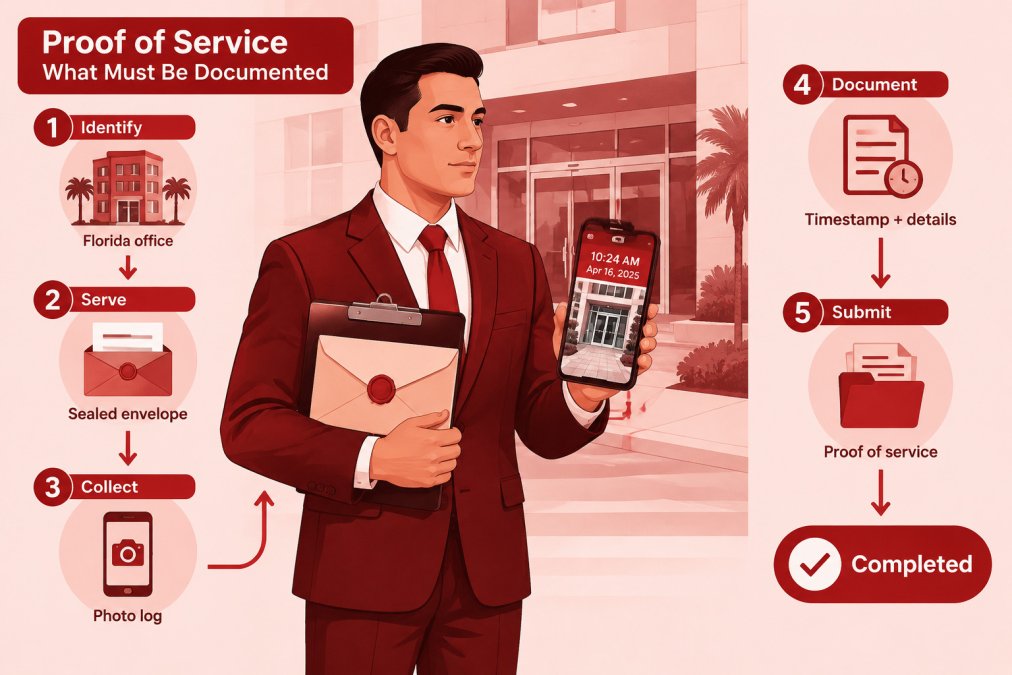
Include the server's full name, license or certification where applicable, and a clear statement of the method used.
!A professional process server in business attire at a Florida office building entrance, holding a clipboard with a sealed legal envelope and a phone showing a timestamped photo log
The proof of service must capture the core details of each delivery, so the table below summarises what it should contain.
| Element | What it records | Why it matters |
|---|---|---|
| Person served | Full name of recipient | Confirms the correct witness was reached |
| Date and time | When service occurred | Shows timing against the compliance date |
| Place | Location of delivery | Establishes where notice was given |
| Method | How papers were delivered | Determines whether service is valid |
| Server identity | Name and license or certification | Shows the server was eligible to serve |
| Sworn signature | Signed return | Makes the return enforceable in court |
Subpoena Delivery Tracking and Chain-of-Custody Records
Real-time tracking lets the attorney's office see where each subpoena stands, from assignment through attempts to completed service. Chain-of-custody records document who handled the papers at every stage, which matters if the service is later challenged. Ask any provider whether it provides timestamped status updates and retains the full attempt history. Storing the packet and return securely also protects privacy for the parties involved.
How to Choose a Professional Process Server
A useful selection process goes beyond simply hiring a professional process server. The harder question is how to compare two providers who both claim to be professional. A practical selection process should verify four things: authority to serve in the relevant court, coverage and turnaround, documentation quality, and cost transparency. Treat each as a separate check rather than a single impression.
1. Verify authority and standing. Ask for the server's full legal name, the jurisdiction(s) where they are authorized to serve, and evidence of any required registration, bond, or appointment. Confirm the server's eligibility against the issuing court's own rules, not just the provider's marketing page. For subpoenas, also confirm the server understands that a subpoena is a court order with a compliance date, not a routine notice letter.
2. Confirm coverage and turnaround in writing. Coverage is not the same as willingness. A provider may advertise statewide service while subcontracting to local affiliates whose availability, hours, and attempt policies differ. Ask which entity will physically attempt service, what hours that entity works, whether same-day and after-hours attempts are available, and what the realistic time to first attempt is for the specific address. Get the answer in the quote, not in a phone conversation.
3. Test the documentation workflow. The return of service is the product that matters. Ask to see a sample completed return and a sample attempt log. Confirm the provider records date, time, location, and outcome for every attempt, captures the server's identity and signature, and can produce timestamped photographs where appropriate. Ask how long records are retained and whether the attorney's office receives the full attempt history or only a final status.
4. Demand itemized pricing. Headline rates hide the cost drivers that actually determine the invoice. A written quote should break out the base service fee, per-attempt charges, mileage or travel surcharges, rush and after-hours premiums, skip-trace or locate fees, and any charges for affidavits, copies, or filing support. Ask what happens to the fee when service fails after multiple attempts, and whether the provider bills per attempt or per completed service. Comparing two quotes without the same line items is not a price comparison.
5. Check accountability and escalation. Ask who the named contact is, how status updates are delivered, and what the provider's escalation path looks like when a recipient is evasive. A reliable provider will tell you in advance how it handles wrong addresses, refused service, gated communities, and recipients who move without notice, and will commit to notifying the attorney early enough to seek alternative service or an extension before the compliance date.
6. Match the provider to the matter type. A server who handles high-volume eviction notices may not be the right choice for an out-of-state witness subpoena or a records custodian at a hospital or bank. Ask for examples of subpoena service in the relevant court and, where records are involved, how the provider handles service on registered agents and custodians of records under the applicable rules.
Watch out: a low headline rate paired with per-attempt billing and mileage surcharges can cost more than a higher flat fee once two or three attempts are needed, so compare total expected cost for the realistic attempt count, not the advertised starting price.
Booking Your Next Subpoena Delivery With US Process Servers
US Process Servers LLC handles subpoena delivery, document filing and affidavits with photos for legal teams in Central Florida. To arrange service, visit the Process Serving page, or contact us directly to request a quote and confirm the requirements for your case. For more detail on valid delivery, read The Complete Guide to Valid Service of Process, and for guidance on choosing a server in your state, see How Do You Hire a Process Server in Florida?. If you need documentation that will hold up in court, review How to Make Process Server Affidavits Court Compliant.
Relevant external references on the rules governing service and subpoenas include Florida Rules of Civil Procedure and Florida Statutes on subpoenas and witness service, which should be checked against the version in force for your matter.
Frequently Asked Questions
How are court subpoenas delivered?
Court subpoenas are usually delivered by personal service, meaning a process server or another eligible adult hands the document directly to the witness. Florida rules generally require that the subpoena be served with the witness fee and mileage payment where required, and that service be completed a reasonable time before the appearance date. Some jurisdictions permit delivery by certified mail or other methods, but personal delivery is the most reliable way to create a clear record. Confirm the specific requirements in the Florida Rules of Civil Procedure and the rules of the court where the case is pending before choosing a method.
What if I don't answer the door to a process server?
A process server who cannot reach you at the door may leave the documents in a manner allowed by the applicable rules, or make additional attempts at different times of day. Repeated attempts are documented with dates, times, and observations. Ignoring a process server does not necessarily prevent service, and in some circumstances courts allow alternative methods once diligent efforts have failed. Anyone served with a subpoena should review the document promptly and contact the issuing attorney or the court with questions.
Who typically delivers a subpoena?
Who may serve a subpoena depends on the rules that apply, so confirm eligibility with the issuing court. Attorneys often hire professional process servers because they know the procedural requirements and can document the service properly. Whoever delivers the subpoena must be able to testify about how and when it was served, which is why accurate documentation matters.
What is someone who delivers legal documents called?
A person who delivers legal documents is commonly called a process server. Process servers deliver summonses, complaints, subpoenas, and other court papers, and they complete a sworn proof of service describing how the documents were delivered. Licensed or registered process servers in Florida must follow state requirements for their work, and a professional process server can help ensure that delivery meets court deadlines and documentation standards.
What should you look for in a professional subpoena delivery service?
Look for a provider that offers personal service, clear proof of service documentation, and a written process for handling failed attempts. Ask how the company tracks attempts and status updates, what service areas it covers, how quickly it can start work, and how it charges. Pricing depends on the number of recipients, the service address, the number of attempts, and any rush requirements, so request a written quote from US Process Servers LLC rather than relying on general estimates.
What information does a process server need to deliver a subpoena?
A process server typically needs the recipient's full legal name, the most current service address, the issuing case number and court, the subpoena document itself, and the date and location of the required appearance. Any witness fee or mileage payment required by the rules should be provided with the subpoena. Accurate identifying details reduce failed attempts and delays, so provide as much verified information as possible.
How is subpoena delivery documented?
Delivery is documented through a proof of service, which is usually a sworn affidavit stating who was served, the date, time, place, and manner of service, and the documents delivered. Many providers also keep attempt logs and photographs of the delivery location or the recipient when lawful. This record is what the court relies on to confirm service, so it should be complete, accurate, and retained with the case file.
What happens if the recipient cannot be located?
If a recipient cannot be located after diligent attempts, the process server documents each attempt and reports the results to the requesting attorney. Options may include skip tracing to find a current address, using alternative service methods if the court permits them, or asking the court for guidance. Attorneys should act quickly when a deadline is approaching, since delays can affect the hearing or deposition schedule.